

Marbles The Brain Store Game Design
Explaining Blockchain with Squid Game

A couple of days ago, on one of the numerous MBA parties, I was asked a very common "party" question: "What is Blockchain?".
Of course, I sneaked from the answer by throwing a very stupid joke, but after that I tried to strain the remaining part of my brain. I realised that there is a lot of unstructured information in my head about Blockchain, mining, crypto currencies and all other fancy stuff people love to discuss while drunk.
So, after spending a c o uple of evenings on YouTube, watching videos like "Blockchain in two minutes", "crypto explained" or "bitcoin simply" I tried to put all of this information into one big picture.
I will present my vision of Blockchain in this article, and please, if you find any inconsistencies or errors — let me know.
So, what is Blockchain?
For now, let's put all the geeky and nerdy tech stuff and let's imagine a group of people playing with marbles (Hello, "Squid Game"; https://www.netflix.com/title/81040344).
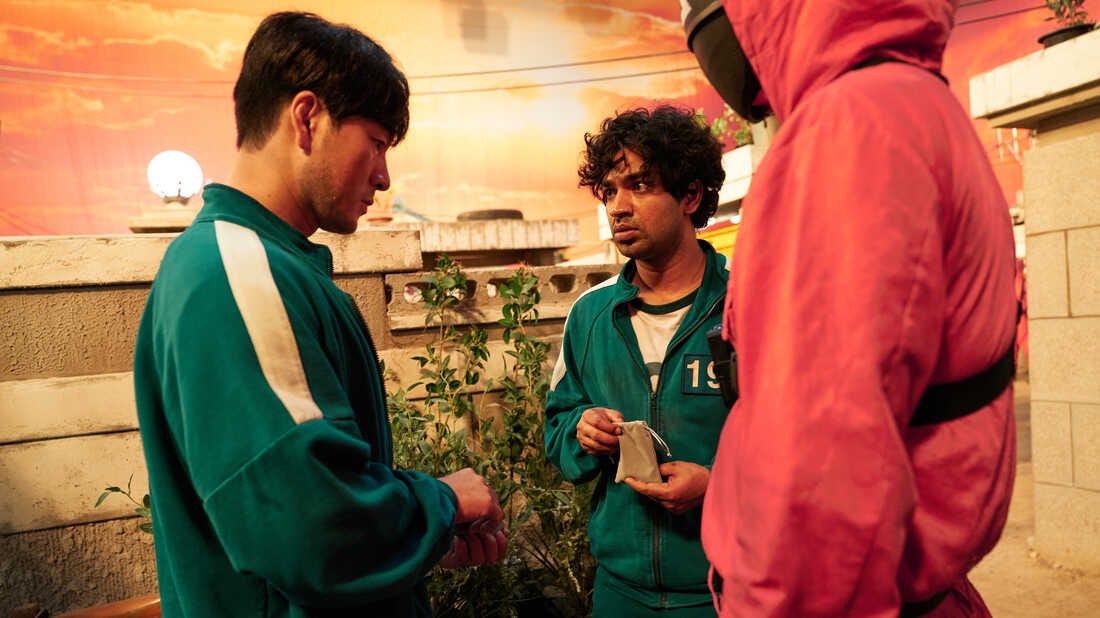
By the way, from now on, I will refer to "Squid Game" A LOT, only for simplicity of explanation, but there is no need to watch the TV Show, unless you are really interested in the Show itself :).
So let's imagine that our game participants are separated into two groups: "Greens" & "Pinks".
In our game, greens exchange marbles with each other. Right now, unlike Squid Game, we should not care about why they are exchanging marbles, what interests us, is how they handle them.
Let's imagine participant 067 wants to give 7 marbles to participant 001. In our imaginary game rules, every marble handling needs to be validated, to avoid cheating and stealing.
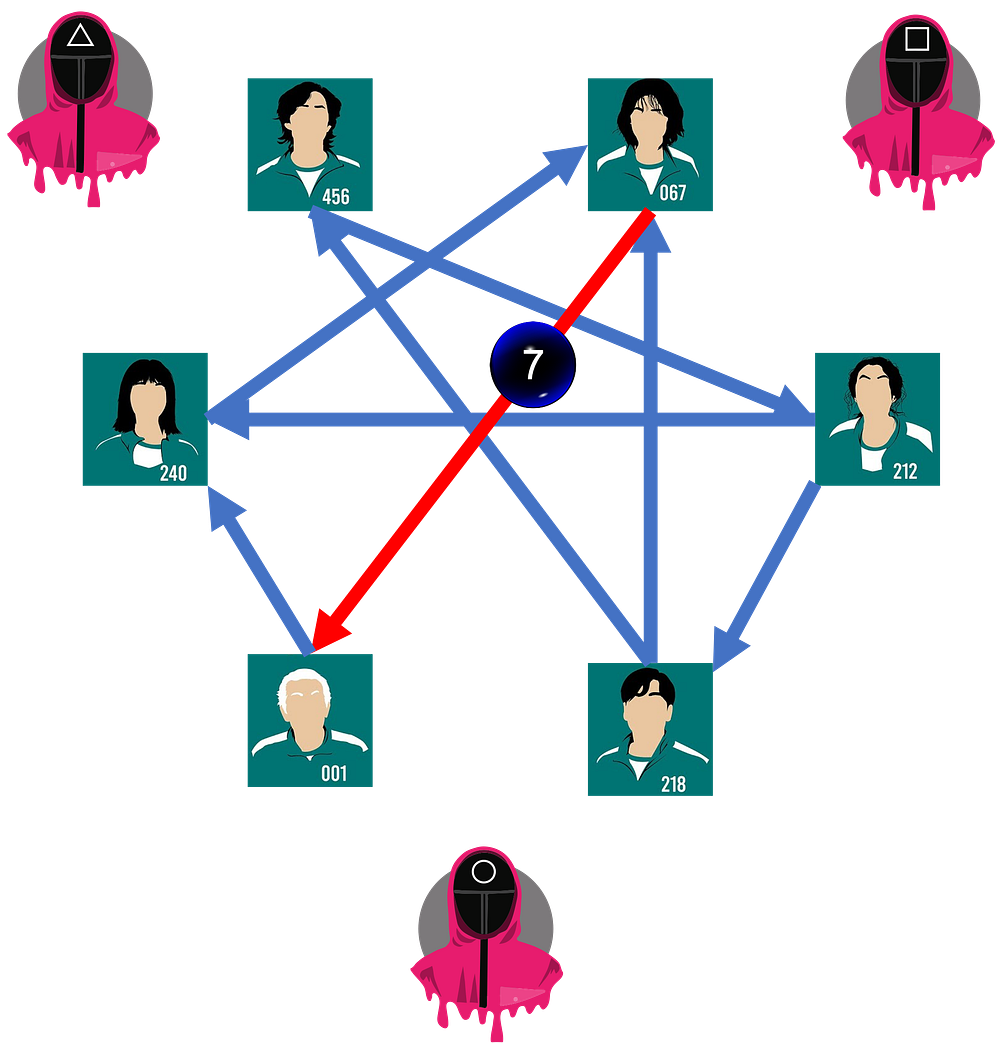
Now come in our Pink players, their main responsibility is to validate the exchange. For example, they need to double check that 067 has enough marbles to handle to 001, i.e., they need to check that 067 has 7 or more marbles. Besides transaction sanity check, there is a bit more complex procedure, which I will talk about a bit later on. For now, let's assume that all Pinks work to validate the transaction, and when it is validated, every pink records the transaction in her or his personal notebook.
All transactions are being recorded one after another, every transaction references previous transaction, and there are no "same-time" transactions.
I managed to steal notebook from one Pink, here are some transactions from it
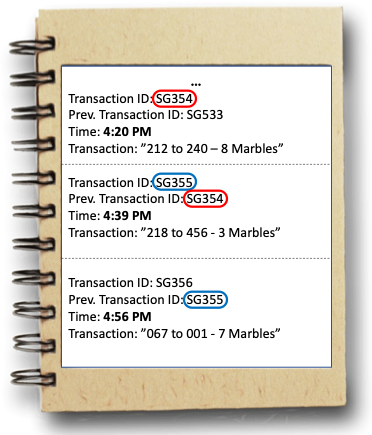
As you can see, every new transaction (newest is on bottom here) refers to previous one by their unique identifier: "Transaction ID". What is also notable, that all Pinks' notebooks are identical, that means that you will find the same records in the same form in every notebook. Hereby, even if I steal or modify data in any particular notebook — it will be useless, because other Pinks still have their notebooks unchanged, and they can reconcile with each other.
So, let's sum up, the process:
- 067 handles 7 marbles to 001
- Pinks work to validate the transaction (they need to confirm that 067 has more than 7 marbles)
- Each Pink records every confirmed transaction into their personal notebook
Simple, yes?
Sooo, this is how Blockchain works.
The marbles are pieces of data, which are called blocks. Every new marble transaction (or block) has reference to previous transaction-block, hereby forming a chain of blocks.
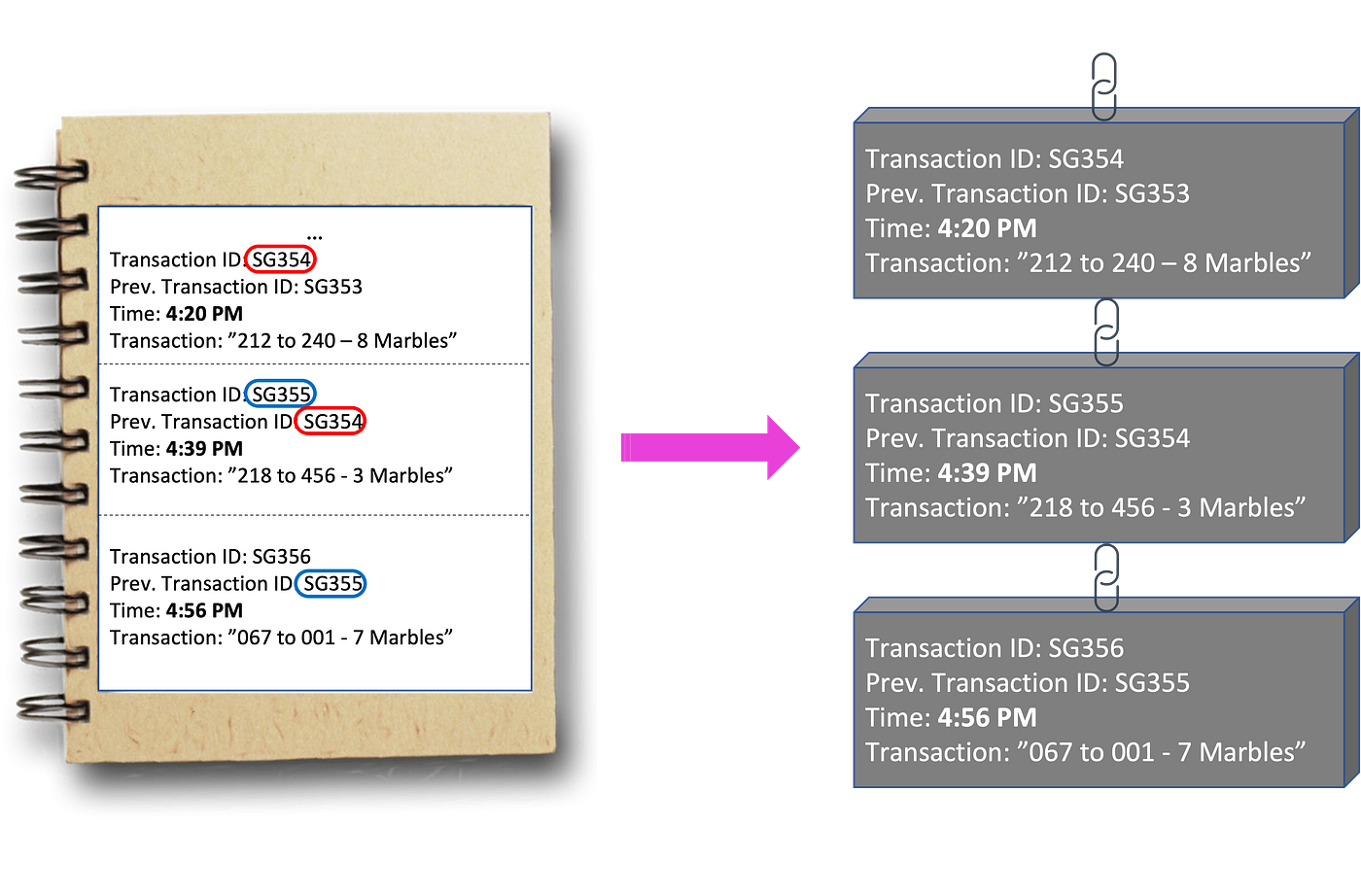
The game participants (Greens) are network users, or literally every device that operates in in the network.
Every block is validated by Pinks, or miners. And after validation, each pink stores transaction into his notebook. Or, in a new terminology, every miner in the world stores Blockchain history locally on his device. That means that history of transactions is accessible on all devices — network participants at the same time. This is why Blockchain is called a decentralised system.
Please also note, that in Blockchain, unlike our Squid Game, Pinks (or miners) can also exchange marbles (blocks) as much as Greens (participants) can.
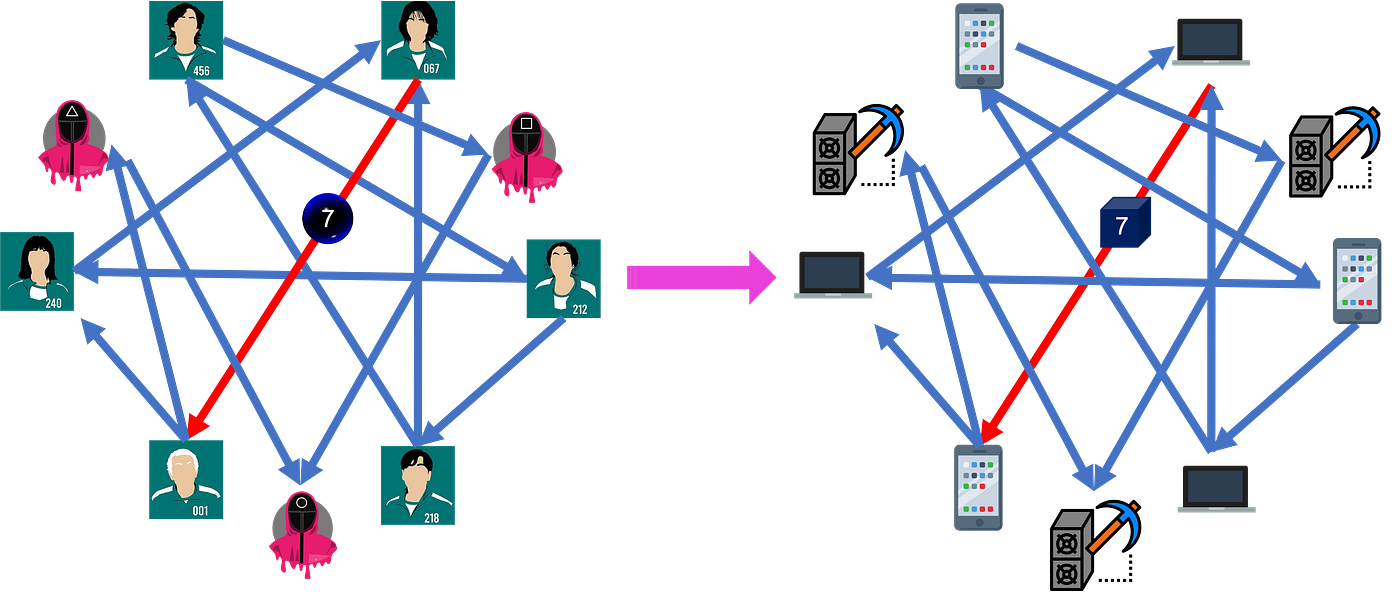
And this is what we get:
marbles, notebooks, greens and pinks >>> blocks, chains, network.
In real Blockchain data in the blocks may contain different information, for example:
- Every block contains information about currency transfer, this is the most common application of Blockchain — this is what we call crypto currency.
- Imagine that with every marble, there comes a note with information. For example, the note, which contains certificate of ownership of the asset (For example, "The one who has this note owns a particular car"). This is example of NFT network.
- The data may also contain medical record history in blocks: https://medicalchain.com/en/.
Now, let's talk about transaction validation (or mining) a bit more
Just in case, all of the below is mostly related to cryptocurrency. Different Blockchains have different validation rules and procedures. I chose crypto just to have general understanding of how mining works.
Let's again forget all this Blockchain terminology and come back to our Squid Game.
Imagine, that in the room, where our Squid game is happening, there is a large box of marbles in the corner.
As we know, after game participants (Greens) state that they want to handle marbles to each other, Pinks need to validate this transaction.
So when transaction is initiated, Pinks compete to validate it as soon as possible. The winner of the competition and gets marbles from the marble box in the corner. This is called mining reward.
To win the competition following things need to be done:
- Pink should check whether transaction can be executed (in our case, it's just a sanity check, that participant 067 has 7 or more marbles)
- Pink should be the first one to solve a difficult mathematical problem
- The solution of the math problem needs to be double checked by all other Pinks
As you already guessed, this is Squid Game analogy for mining. The mining competition is called Proof of Work.
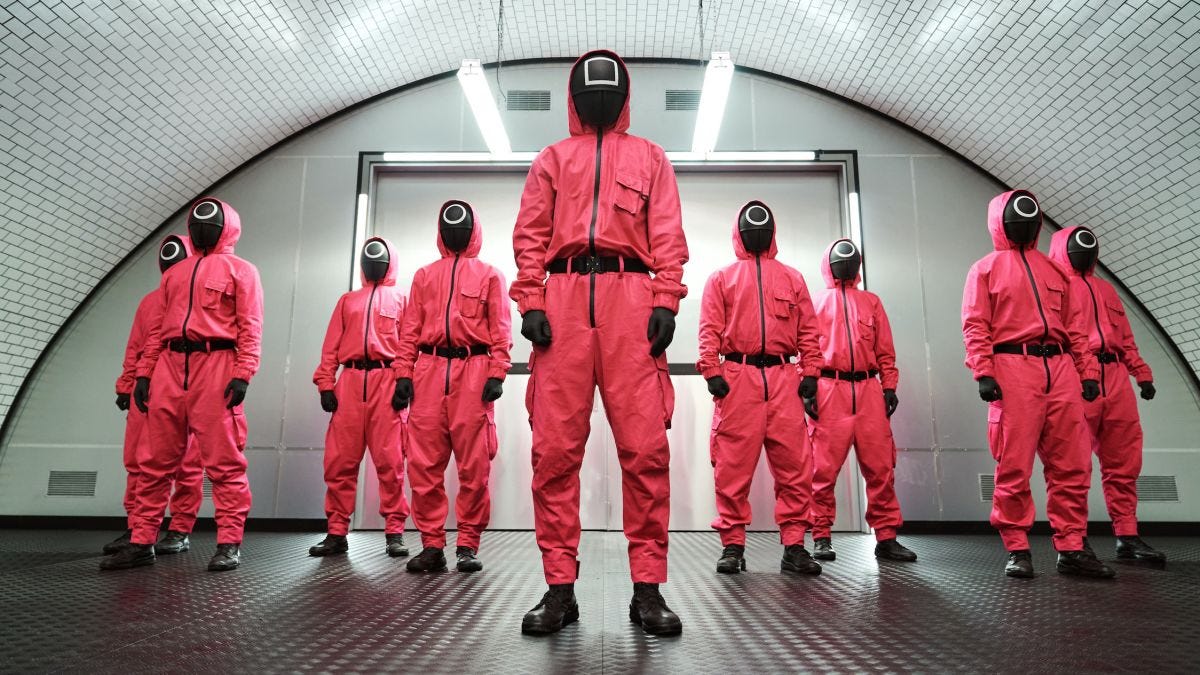
But why is Proof of Work important?
Let's imagine in our Squid Game, there is no mathematical problem (or Proof of Work). That means that Pinks do not spend any additional effort on transaction validation.
If I am a Pink and I only need to validate the transaction ASAP to get the reward, I will shout out validation results, even without validating them. But if I spend some time on solving problem, then I better double check the validation results, as far if I submit wrong results, I will spend my effort on solving the for nothing.
So, mathematical problem is "Proof", that Pink spent some effort or "Worked" on transaction validation.
The same is in Blockchain, Proof of Work is just an evidence, that miners do not bulls**t the network and are serious in validating the transaction.
For each network, Proof of Work may be different. For example, in BitCoin network, it is simply a complex computational problem, which requires large amounts of computational power. And you know what value does solving this problem bring to humanity? No value at all, BitCoin network Proof of Work is useless and made JUST FOR LULZ.
Anyways:
Pinks, mathematical problems, marbles from the box >>> Miners, Proof of Work, Mining Reward
Why Blockchain is so popular right now?
Blockchain has many really cool features, here are some of them:
1. Decentralisation — there is no single peer controlling the network. Network participants all together maintain the network. To amend information in the Blockchain, hacker needs to hack at least 51% of the devices that store Blockchain.
2. Security — I did not talk about this in the article to keep it simple, but trust me everything here is SUPER encrypted, and hacking Blockchain network is a very big challenge not only because of encryption, but also because of decentralised architecture.
3. Openness — all transactions are in open access (or partially open), and everything is ultra-traceable.
For now, Blockchain's most frequent application is Cryptocurrency & Decentralised Finance (DeFi). But there is a great deal of opportunity in the applications in different industries: healthcare, supply chain, government, and other industries.
I think this is it, I tried to cover all main Blockchain features such as blocks, chains, mining, proof of work. Of course, Blockchain is a way more complex type of systems than our Squid Game, but I hope it gives some basic understanding of "what", "how" and "why". If you have any comments or remarks — please let me know. I hope you enjoyed reading. Peace ❤
P.S. Thanks to my friends and family, who spent an enormous amount of time re-reading my article and sending their comments.
P.S.S. Special thanks to Varun Rekhi & Maximilian Bräuninger for reviews and ideas.
Marbles The Brain Store Game Design
Source: https://dkakaur.medium.com/explaining-blockchain-with-squid-game-a2bf87984c9?source=rss------technology-5
Posted by: butlerhateres.blogspot.com
0 Response to "Marbles The Brain Store Game Design"
Post a Comment